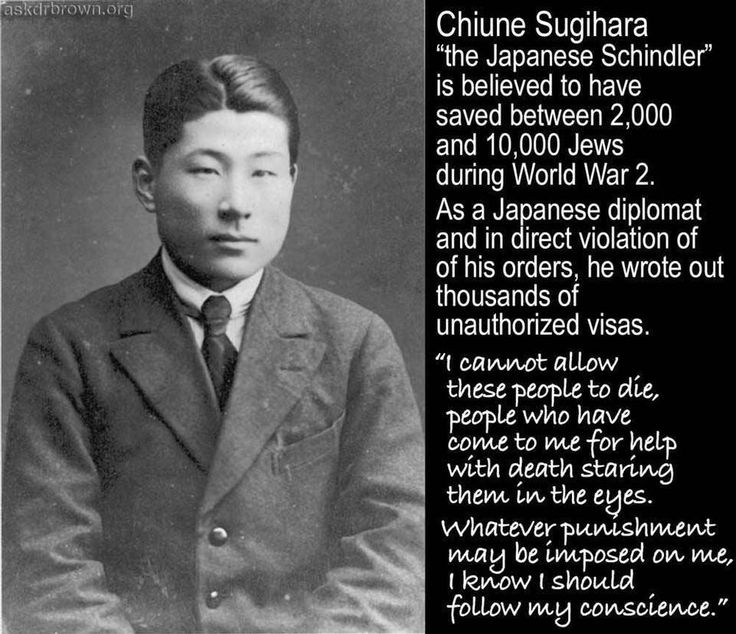
Many years after signing the visas to Japan for the Jews, Chiune Sugihara was asked why he did it. He replied: “They were human beings and they needed help. I’m glad I found the strength to make the decision to give it to them.”
Japan Times Chiune Sugihara, Japanese consul in Kaunas, Lithuania, awoke on the morning of July 18, 1940, to a disturbing sight. He peered through the curtains of his bedroom window just before 6 a.m. Sugihara and his wife had been living in the consulate building since their arrival at the end of August 1939, just a few days before the German Army advanced into Poland.
“The street that the bedroom window of the consulate faced,” Chiune wrote in a memoir more than four decades later, “was suddenly filled with the din and clamor of a large group of people.”
It wasn’t long before the number of people doubled. In subsequent days, several thousand Jewish refugees — primarily from Poland but also from Lithuania and points east — were to come to the consulate in the hope of attaining a Japanese visa and escaping the Nazi tyranny that most certainly awaited them.
Sugihara sent a cable — he was to send three in all — to his superiors at the Foreign Ministry in Tokyo, asking permission to issue transit visas to refugees. He was instructed NOT to do so. The case came to the attention of Foreign Minister Yosuke Matsuoka, who was troubled lest Sugihara’s actions stain his impeccable credentials with his Nazi allies, even though Matsuoka was in no way anti-Semitic himself and made public assurances that no Jews would ever be mistreated by Japanese.
At the time, transit visas were only issued to people with legitimate visas to an onward location from Japan and who could prove they had the means to provide for themselves while in the country. Sugihara nonetheless began writing out visas on July 29, 1940, and continued throughout that day and in the following days for the desperate and, in most cases, destitute refugees until, he wrote in his memoir, “my fingers were calloused and every joint from my wrist to my shoulder ached.”
Thanks to Sugihara’s actions, thousands of Jewish refugees found themselves in Japan at a time when that nation was allied to a virulently anti-Semitic Germany. By all accounts, however, the Jews were treated with kindness and magnanimity. Although transit visas at the time were valid for only 10 days, the term was lengthened to a month and, in some cases, longer, until most all of them had been able to arrange passage to onward points such as Shanghai, the U.S., Australia and Brazil.
As for Sugihara himself, he was relieved of his job at the Foreign Ministry two months after his return to Japan. “I was asked to accept the termination of duties without complaint because of ‘you-know-what,’” he told a Fuji TV show in 1977. The “you-know-what” was, of course, his insubordination in the visa affair. This gave rise to the notion that he was being punished for the most “un-Japanese” behavior of breaking the rules.
The Foreign Ministry was anxious to show that the Japanese had not been Nazi puppets and that some good deeds had been done. In disrepute after the war, the government tried to take credit for Sugihara’s altruism. This is a shining example of the actions of a single, brave individual subsequently being claimed by an institution that, in actuality, strove to foil him.
It was only in his last years that his courageous story came to light; and only after his death on July 31, 1986, that the government acknowledged his acts of conscience. In 1992, a monument to Sugihara was unveiled in his hometown of Yaotsucho, thanks to an initiative supported by former Prime Minister Noboru Takeshita. There is also a museum in the town dedicated to his life and memory.
Perhaps the following words of Chiune Sugihara are the most eloquent on his contribution to humanity: “I took it upon myself to save (the refugees). If I was to be punished for this, there was nothing I could do about it. It was my personal conviction to do it as a human being.”
I had never heard this story until 2009, even though I spent 2 years living in Japan in the 1970’s. I don’t think many people know about this very courageous man. –BNI
The following is a personal story from BNI reader, Jane, in Canada, about her own family’s indebtedness to Mr. Sugihara and his wife:

Consul General Sugihara and his family are heroes in every sense of the word. My father-in-law and his brother would never have survived the Holocaust, had it not been for him. Nor would my family exist, if it hadn’t been for these truly remarkable people who risked their own lives, and the lives of their children, to save Jewish lives.
Once they arrived in Japan, Dad and his brother stayed in a ghetto that had been set up for Jewish refugees. Eventually, they were moved over to Japanese occupied Shanghai. Dad said that the conditions were difficult, but that they were treated fairly by the Japanese authorities. They were allowed to have representatives who would meet with the authorities, and get requests fulfilled to improve the living conditions. Dad had a number of booklets that were in Japanese for various Jewish Holidays. The Japanese versions of the various festivals were provided by the Japanese Government, so that the Jewish community could learn to read and speak the language.
The Jews who remained in Japan, were always conscious of the relationship between Japan and Germany, so there was fear that at some point they would be transferred over to the Germans. They did realize that to a large extent they were being used as pawns, by the Japanese Government in its dealings with Germany. However, despite being used as pawns, they were always deeply grateful that Japan accepted Mr. Sugihara’s visas, allowed them to enter, and provided food, and sanctuary.
Without Sugihara, it is likely that the majority, if not all of these Jews, would have perished at the hands of the Germans. My father-in-law’s entire family – parents, grandparents, sisters, uncles, cousins – barring 1 cousin – were all annihilated by the Germans in their town in Poland.
Despite the lack of publicity, Mr. Sugihara and his family have never been forgotten by the Jews that they saved. The family is revered, and as shown in your post – monuments and parks have been created to honor this man.

Mr. Sugihara and his wife were remarkable human beings – in every sense – during extremely dangerous times. Sugihara’s family could have easily suffered at the hands of the Nazis or the Japanese authorities. Their courage was phenomenal. During such dangerous times, it is no small thing to hold onto one’s values, and risk everything for the life of a stranger.
I remember Dad talking about the Trans-Siberian train that he took from Lithuania. He said that throughout the entire trip, they were terrified of the Russians, and not sure that they would survive the train trip. While on the train from Lithuania, to the point where they could get a boat to Japan, they were continually harassed and mocked by the Russians on board.
What little belongings Dad, and his brother had on them, were absconded by the Russians, before they reached their destination. I just read, a little while ago, that Sugihara was the one who convinced the Russians to allow the Jews on the train. According to the report, the Russians would only permit the Jews to travel on the train, if they paid 5 times the normal ticket price. Despite what happened to Dad’s family at the hands of the Germans, he always considered the Russians to be worse. This always surprised me in light of what occurred in the Holocaust. I think his feelings must be connected to years of Russian abuses that may have occurred in Poland prior to the war.
Mr. Sugihara and his wife are an important part of our family history. We are a family that would not have existed, had it not been for the courage of the Sugihara Family.
In an odd quirk of fate – destiny – our son married a lovely Japanese girl, and resides in Japan. It’s interesting that our son has chosen to make his home in Mr. Sugihara’s country – the very place that provided his Grandfather sanctuary, and saved his life. Despite how much we miss our son and daughter-in-law, during these troubling times with the rise of anti-Semitism, it gives us a sense of peace to know that our loved ones are safe in Japan. Without the courageous Mr. Sugihara, his wife, and Japan, our family would not exist and there would be no story to tell.
There are righteous people in all generations who follow their conscience instead of the crowd.
My great hope is that Mr. Sugihara was a Christian, when he died. I want to be able to shake his hand and thank him, when I get to heaven.
– John Little, http://www.omegashock.com
Amazing moral courage. I had never heard this story fully, so it is important that it be told.
Fascinating story! It’s interesting to contrast Japanese Consul General Sugihara with German businessman and Nazi party member, John Rabe, who helped save 200,000 Chinese in Japanese-occupied Nanking, China, during the 6 week long Japanese offensive against Chinese civilians known as “The Rape of Nanking.” During those 6 weeks, Japanese soldiers killed 200,000+ Chinese civilians at a rate which extrapolates out to 19 million over 11 years. There’s just no predicting where tiny little pockets of humanity will spring up during wartime.
An honourable man counted amongst the few that were so. Sadly, most of Europe readily gave up their Jews to the evil of fascism and many, too many were active participants in the slaughter. It was not Christianity’s finest hour.
MT, but there were many stories of Christians hiding Jews at that time.
My friend grandfather Jewish fled from Austria to Poland on fake documents. He was working for underground polish government during WW2 and was killing all people collaborated with Nazi Germans. Many Polish risk their lives to save Jewish family’s.
Poland changed Law now if anyone will say “Polish death camps” will face fine or 3 years in prison. Israel is opposed this. Why? Poland was occupied by Nazi Germans. Camps was in German hands. And Israelis politics stand with nazi Germans who killed millions of Jewish, Polish etc.
On the top of gate to Auschwitz is written in German” Arbeit macht frei” means”Work make you free”
Rabin in Poland said few years ago Poland need to pay 65 Milliard Dollar as compensation to Jewish people after war. We were attacked by Germany than Soviet Union. Occupied for 50 years and now they demand money.
Germany never paid reparation to Poland.
Israel got reparation from Germany.
Ship full of Jewish people during WW2 was turned to Europe from Miami port in America most of them was killed by nazi germans.
Truth is big problem now. Fake news, changing history.
If you say 50 time fake news people will think its truth. That what happened now.
Thanks God we have Bonnie and her cat.
Polish, I have been reading about that and I disagree with Israel. While there were many Poles who didn’t like Jews and probably were happy to help the Nazis, I would never call the death camps Polish. They were German Nazi death camps set up in Poland. I don’t know why after all these years, this has become an issue. And I also know that a lot of Poles helped the Jews.
Thank you for posting this.
Honour and bravery against pure evil should, in the very least, be remembered.
Wow, this is a stunning story. I had no idea of this. Can good be found in the depths of savagery? Evidently. This man should be remembered for what he did, I know I’ll not forget him.
There were almost as many Christians murdered by, that devil Hitler, as there were Jews, many because they were trying to hide the Jewish people. Hitler hated Christians also and had determined to eradicate them too. Mr. Sugihara was an orothodox Christian.
Jane, I am so grateful for what Mr. Sugihara did for your family.
thank you for posting this. Yes, he is a true hero and Israel has a memorial to him.
May his memory always be for blessing.
May all Holocaust victims be bound in G-d’s eternal light. AMEIN.
Wonderful hero! May he, and the thousands of Jews he saved, have many descendants!
There are many amazing and wonderful stories of heroes who saved Jewish lives during the Holocaust.
A brave and honourable man indeed.